International Newsletter IDT | Issue 2 in 2026
Read Online
Header The SealMate by IDT

PFAS: The Decisions Being Made Now Will Shape What's Still Permitted.


{IF[FAMILYNAME]}{IF[SALUTATION=="Herr"]}Dear Mr. {FAMILYNAME},

{ELSEIF[SALUTATION=="Frau"]}Dear Ms. {FAMILYNAME},

{ELSE[SALUTATION]}{ENDIF[SALUTATION]}{ENDIF[FAMILYNAME]}PFAS regulation is entering a decisive phase: the applications that will remain permissible — and those that won't — are being determined right now.

Last week, ECHA launched its second consultation, which is open to companies and stakeholders worldwide — not just those based in the EU. However, findings must be submitted by May 25, 2026 via a structured questionnaire.

For many industrial applications, the situation remains challenging: technically equivalent alternatives are often unavailable — particularly for fluoropolymers such as PTFE.

What we're seeing in practice:

  • approximately 30% of PTFE gaskets currently in use cannot be readily substituted
  • alternatives frequently fail to meet the required sealing performance or chemical resistance in critical applications

This makes the current phase critical: regulators are now assessing which applications can be feasibly managed under real-world conditions. The basis for these decisions is socioeconomic impact data and industry field data.

In the latest IDT podcast, Jörg Skoda, Technical Director at IDT, and Dr. Frauke Averbeck, scientific advisor for REACH and CLP at the Federal Institute for Occupational Safety and Health [BAuA], discuss proportionality, substitution, and what this means in practice for companies.

The IDT Podcast is available on all podcast platforms and as a video on YouTube.

PRODUCTS

H2

Sealing at the Extremes.

Cryogenic applications are increasingly coming into focus — in LNG, hydrogen, and oxygen systems, among others. Extremely low temperatures place direct stress on materials and sealing systems, pushing even established solutions to their limits.

In demanding operating conditions, conventional adhesive-bonded laminated seals in metal-graphite construction are frequently used. Under extreme conditions, this can become a liability: adhesives embrittle and cause structural weaknesses. In oxygen applications, organic components can even ignite, posing a significant safety risk.

Adhesive-free laminated seals offer clear advantages:

  • no embrittlement from adhesives
  • reduced contamination risk
  • stable mechanical properties across low and high temperatures

IDT's LE-SAFE technology addresses this directly: gasket integrity is achieved not through adhesives, but through design and mechanical clamping. This eliminates a key weakness of conventional solutions and enables reliable sealing performance even under cryogenic conditions. Cammprofile gaskets and corrugated metal gaskets are also available from IDT in adhesive-free versions.

Explore the technical details.

MARKET

IDT Podcast Titelbild

Strengthening International Development at IDT.

IDT is expanding its international market presence: Matthias Muehl joined the International Development Team at the start of the year.

Drawing on extensive experience in the gasket industry and international markets, he will develop partnerships with distributors and customers and open up new market opportunities.

Muehl spent many years in New Zealand, where he built and grew his own company in international markets. He now brings that entrepreneurial, market-driven perspective to IDT's European and global activities.

For our partners and customers, this means closer collaboration, a deeper understanding of local requirements, and a structured approach to developing shared business opportunities.

If you'd like to meet Matthias in person: he's always available for a direct conversation and just a phone call away. He will also be at the International Valve Summit in Bergamo from May 19–21, 2026.

Feel free to reach out.

Foto Matthias Muehl

MATTHIAS MUEHL
International Business Development
m.muehl@idt-dichtungen.de

BEST PRACTICE

Audit-Ready. Every Day.

When your plant is audited, your supply chain is under scrutiny too — the process stability, documentation, and traceability of every supplier. We know this from experience.

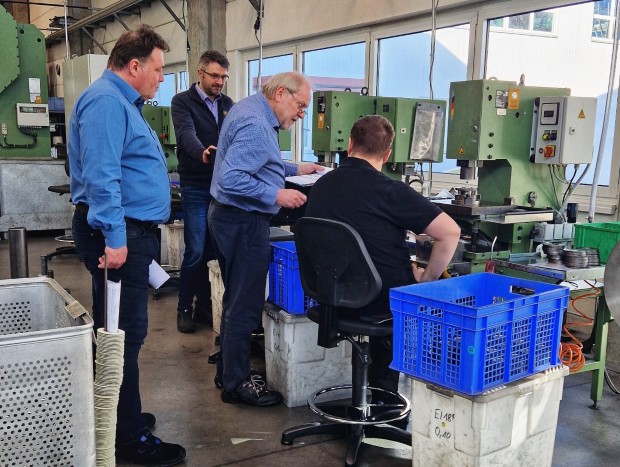
Our integrated management system was successfully audited again — at our production in Saxony. ISO 9001 certification was also reconfirmed across all sites. For us, formal certification is only part of the picture. Processes need to be stable and reliable in day-to-day operations — across the entire organization. In practice, that means:

  • consistent quality across batches and sites
  • traceable, documented workflows
  • stable processes under demanding operating conditions

As a mid-sized manufacturer, we combine structured management systems with short decision-making paths — and translate requirements into practice, consistently.

Questions about our processes, certifications, or documentation — for example as part of a supplier qualification?

Feel free to talk directly to David Gäbelein.

Foto David Gäbelein

DAVID GÄBELEIN
Head of Quality Management
d.gaebelein@idt-dichtungen.de

PERSPECTIVES

Doing Over Declaring.

Over the past few months, I've been on the road a lot — visiting customers, attending trade shows, meeting with partners. The conversations often centered on transformation, strategy, and visions for the future. And time and again, I notice the same thing: the critical question is rarely what we set out to do, but whether we actually get it done in practice.

Whether processes hold up when it matters. Whether decisions get made when they're needed. Whether accountability sits where it has impact. Being reliable doers doesn't show in ever-new promises or polished presentations. It shows up on the floor: in our production, in how we handle customer situations, and sometimes very directly when an audit comes around and we get unfiltered feedback from the outside.

That's precisely our strength. We're close to where the work gets done. Close to the actual applications, the technologies, the people in our organization — and close to you.

Progress rarely comes from large-scale programs. It comes from many decisions at the operational level, carried through consistently. Not spectacular. But effective.

Curious to hear your perspective — similar or not.

Let's talk.