Lightning Current-Capable Gaskets in Flange Connections Greater safety thanks to tested electrical conductivity
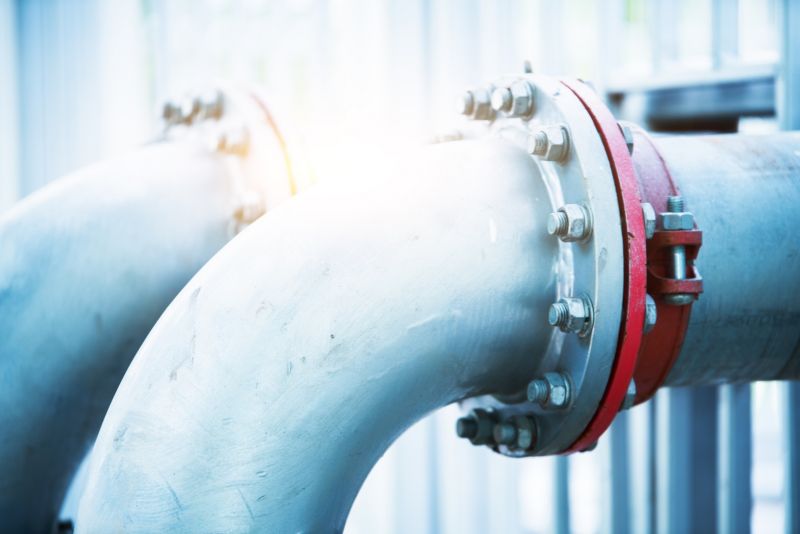
Lightning current-carrying gaskets are a safety-relevant component in flange connections in industrial plants. In addition to providing reliable sealing, they perform a crucial function in the lightning protection system: they ensure electrical potential equalization and prevent dangerous voltage differences in the event of a lightning strike.
Especially in potentially explosive areas (Ex zones), electrically conductive gaskets are therefore not an optional accessory, but a central component of plant and personal protection.
Why electrically conductive gaskets are crucial in lightning protection
In industrial applications in the gas and water industry, energy distribution, and the process industry, lightning protection measures are an indispensable part of the safety concept.
The focus is often on lightning conductors, grounding systems, or surge protection devices. Gaskets in flange connections, on the other hand, are often underestimated, even though they play a central role in the current path.
In the event of lightning, electrically non-conductive gaskets can cause:
- cause dangerous potential differences
- promote sparking
- damage components
- increase risks to people, the environment, and equipment
Lightning current-carrying, electrically conductive gaskets, on the other hand, ensure a defined potential equalization between the flange connections and thus make an active contribution to lightning and explosion protection.
In practice, we repeatedly see that gaskets are underestimated in lightning protection. In an emergency, however, safe potential equalization at flange connections is crucial for plant availability and personal safety.
DIN 30691:2024-12 – New standard for lightning current-carrying gaskets
With the publication of DIN 30691:2024-12, a binding, testable standard for electrically conductive and lightning current-carrying gaskets in flange connections is available for the first time.
DIN 30691 regulates:
- the requirements for lightning current-carrying gaskets in flange connections
- the standardized test methods for verifying electrical conductivity and lightning current carrying capacity
- the suitability of gaskets for lightning protection systems in industrial plants
The standard is closely linked to DVGW worksheet G 491, which describes protective measures for gas pressure regulating and measuring systems.
The aim of the standards:
- Prevention of damage to plant components due to lightning strikes
- Increasing operational safety
- Active protection of people and the environment
Gaskets capable of carrying lightning current must meet these requirements
When used in hazardous areas and safety-critical applications, lightning current-carrying gaskets should have the following properties:
Electrical conductivity
Only electrically conductive gaskets enable reliable potential equalization between flange connections in the lightning protection system.
Tested lightning current carrying capacity
Suitability must be verified by a standard-compliant test in accordance with DIN 30691 – ideally documented and certified.
Material selection and design
In addition to electrical conductivity, seals must meet process-specific requirements:
- Pressure
- Temperature
- Medium
- Mechanical stress
Durability and ease of maintenance
Durable, robust gaskets with low leakage rates are crucial for minimizing maintenance costs and downtime, especially in areas of the plant that are difficult to access.
Our gaskets: Standard-compliant, tested, ready for immediate use
IDT already offers lightning current-carrying gaskets that meet all the requirements of DIN 30691 – tested, certified, and proven in practice. These include the corrugated ring seal with the WD10 profile and the comb profile gaskets with the KD01, KD20, KD30 profiles.
Your advantages at a glance:
- High electrical conductivity for safe dissipation of lightning currents
- Mechanical stability for demanding industrial applications
- Suitable for explosion-proof areas (Ex zones)
- Durable design with low leakage values
- Easy integration into existing systems
Thanks to our high level of vertical integration, in-house testing procedures, and reliable sourcing, we ensure consistently high quality—even for short-term needs or individual requirements.
Frequently asked questions about lightning current-carrying seals
Lightning current-carrying gaskets are electrically conductive gaskets that enable safe potential equalization in flange connections. They ensure that lightning currents or surges are dissipated in a controlled manner and that no dangerous voltage differences arise.
In lightning protection systems, all conductive parts of the system must be connected to each other. Electrically non-conductive gaskets can interrupt this current path. Lightning current-carrying gaskets close this gap and contribute significantly to system, personal, and explosion safety.
Lightning current-carrying gaskets are particularly relevant in:
- explosion-hazardous areas (Ex zones)
- Gas and water management
- Gas pressure control and measuring systems
- Energy distribution systems
- Safety-critical process plants
The requirements are based on DIN 30691 and DVGW worksheet G 491, among others.
DIN 30691:2024-12 defines for the first time:
- Technical requirements for lightning current-carrying gaskets in flange connections
- Test methods for verifying electrical conductivity and lightning current carrying capacity
- Criteria for use in lightning protection systems for industrial plants
It thus creates a binding basis for planning, testing, and operation.
The test is carried out in accordance with the test procedures specified in DIN 30691. This verifies that the seal:
- can safely conduct high lightning currents
- maintains its function and tightness
- does not cause any dangerous damage
The results should be documented and verifiable.
In many cases, yes. Lightning current-carrying gaskets can be used in existing flange connections without any design changes. However, a technical review of the respective application is recommended.
- Standard safety in accordance with DIN 30691 and DVGW G 491
- Tested electrical conductivity
- High mechanical stability
- Low leakage values
- Durability and low maintenance requirements
IDT's application engineering team can assist you with:
- Selecting the appropriate seal
- Evaluating your application
- Designing your flange connections in accordance with standards
Contact us for individual advice.
Technical article on lightning current-carrying gaskets
Details: Article | DE | Last Changed 2026-05-07 | 1.1 MB Fachartikel aus CITplus 4/2026 über blitzstromtragfähige Flanschdichtungen als sicherheitskritische Komponente in industriellen Anlagen. Die DIN 30691:2024-12 legt erstmals ein normiertes Prüfverfahren für die Blitzstromtragfähigkeit fest. Kammprofil- und Wellringdichtungen von IDT leiten Blitzströme sicher ab und erfüllen die Anforderungen von DVGW G 491 sowie dem KRITIS-Dachgesetz. Autor: Jörg Skoda, Technischer Direktor der IDT Industrie- und Dichtungstechnik.